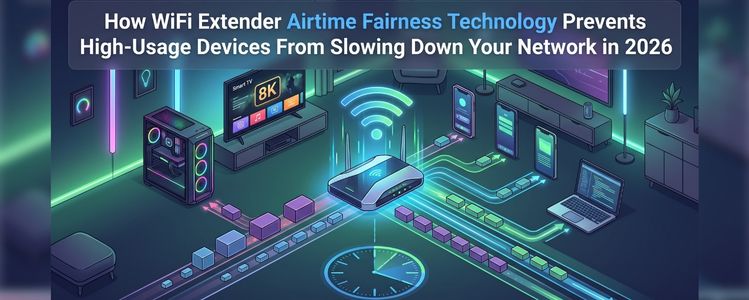
A home WiFi network can become surprisingly busy. One person may be watching a 4K video, another may be attending a video meeting, while smart cameras, phones, gaming consoles, and connected appliances continue using the network in the background. When several devices compete for wireless resources, a few high-usage devices can sometimes consume a disproportionate amount of airtime.
This is where airtime fairness technology can make a difference. Instead of allowing slower or high-demand devices to occupy wireless communication opportunities for extended periods, airtime fairness can help distribute available wireless airtime more efficiently among connected clients.
For homes using WiFi extenders, this can be particularly useful. An extender can improve coverage in areas where the primary router struggles to reach, while airtime management can help connected devices share available wireless resources more effectively. Users managing compatible Netgear networking equipment may also encounter tools and interfaces associated with routerlogin.net admin for network administration and older utilities such as Netgear Genie download.
Airtime fairness is a wireless networking feature designed to manage how much communication time individual devices receive on a WiFi network.
Traditional wireless networks can sometimes allow slower devices to occupy the wireless channel for longer periods while transmitting the same amount of information.
Airtime fairness attempts to address this imbalance by managing access to wireless airtime more efficiently.
The objective is not necessarily to give every device identical bandwidth. Instead, the technology focuses on making better use of the available wireless communication time.
Not all connected devices behave in the same way. A smartphone checking email may only use a small amount of data, while another device could be:
When demanding devices are active at the same time, network congestion can increase. Older or slower wireless clients can also require more airtime to transfer the same amount of information, potentially affecting the experience of other devices.
Airtime fairness attempts to manage wireless transmission opportunities so that individual devices do not unnecessarily dominate the available airtime.
This can help improve the overall responsiveness of a busy network. Potential benefits include:
The actual benefit depends on the router, extender, WiFi standard, client devices, firmware, and network environment.
Internet speed is often the first specification people consider when buying networking equipment. However, a fast connection can still feel slow when wireless airtime is poorly managed. Imagine a highway with plenty of capacity but one slow vehicle occupying an important lane. The problem is not necessarily the total size of the highway; it is how efficiently the available space is being used.
WiFi airtime works in a somewhat similar way. A network with many connected devices needs to manage its wireless communication opportunities efficiently.
A WiFi extender creates an additional wireless access point that helps bring connectivity to areas outside the primary router’s effective range.
In a large home, devices connected through the extender may include:
If several devices are active simultaneously, airtime management can help prevent individual clients from unnecessarily consuming wireless resources.
However, airtime fairness cannot compensate for a weak connection between the extender and the main router. Extender placement remains extremely important.
An extender should generally be placed where it can maintain a reliable connection with the primary router while still providing useful coverage to the target area.
If the extender is positioned too far away, its backhaul connection may be weak.
This can result in:
Airtime fairness works best when the underlying wireless connection is already reasonably healthy.
Modern smart homes can have dozens of connected devices. Examples include:
Some devices constantly exchange data, while others only communicate occasionally. Airtime management can help the network handle this mixture of traffic more effectively.
Streaming services can consume significant bandwidth, particularly when multiple devices are watching high-resolution video.
Suppose one household is streaming 4K content while another user is working remotely and several smart devices are transmitting data.
Without efficient wireless resource management, congestion may affect the overall experience. Airtime fairness can help distribute wireless opportunities more effectively, although it does not create additional internet bandwidth.
Gaming is particularly sensitive to latency and connection consistency.
A large download occurring on another device can compete for network resources and potentially affect responsiveness.
Airtime management can help create a more balanced wireless environment, but gaming performance also depends on:
For latency-sensitive devices, a wired Ethernet connection may still provide advantages where practical.
Some compatible Netgear routers and extenders provide web-based management interfaces. Users may encounter routerlogin.net admin pages when accessing supported Netgear router administration tools.
Depending on the specific model, the management interface may provide access to:
The exact features and login methods vary by device.
Older Netgear networking products were associated with the Netgear Genie utility.
Users searching for Netgear Genie download should first verify whether their particular router or extender actually supports Genie, because newer Netgear products may use different management applications or interfaces.
Using software designed for the specific networking device helps avoid compatibility issues.
Network firmware can influence how wireless features operate. Manufacturers may release updates that address:
Keeping supported networking equipment updated can therefore be an important part of maintaining reliable WiFi performance.
Airtime fairness is useful, but it is not a universal solution for network congestion. Other causes of poor performance may include:
A good troubleshooting process should consider the entire network rather than focusing on one feature.
Wireless networks are becoming increasingly adaptive. Future systems may combine airtime management with:
These technologies could allow home networks to automatically adjust as device activity changes.
WiFi extender airtime fairness technology can help prevent high-usage or slower devices from unnecessarily dominating wireless communication time. This can be particularly valuable in busy homes where streaming, gaming, video conferencing, smart cameras, and connected appliances operate simultaneously.
However, airtime fairness is only one part of a reliable wireless network. Proper extender placement, a strong backhaul connection, suitable hardware, updated firmware, and sensible network configuration remain equally important.
For users managing compatible Netgear equipment, routerlogin.net admin may provide access to supported router management settings, while users considering a Netgear Genie download should first confirm that Genie is compatible with their specific model.
As connected homes continue to grow in 2026, intelligent airtime management will become increasingly valuable for keeping wireless networks responsive and ensuring that one demanding device does not unnecessarily affect everyone else’s online experience.
Tags: WiFi Extender
Dave Francis is a WiFi network expert and a technical writer dedicated to helping users optimize their home networks. He focuses on providing clear, actionable steps to help readers get the best service out of their devices. With the background in Information-Technology and passion for WiFi devices, he provides practical advice and solutions for setting up and managing Wi-Fi devices. He breaks down technical issues and offers simplified solutions through easy guides and tutorials.


