Reliable WiFi coverage has become essential for modern households. Large homes, multi-story properties, thick walls, and increasing numbers of connected devices can make it difficult for a single router to deliver consistent wireless performance in every room. WiFi extenders help address these coverage challenges by expanding the network into areas where the primary router’s signal may be weaker.
In 2026, intelligent beamforming is becoming an important technology for improving how WiFi extenders communicate with connected devices. Instead of distributing wireless energy uniformly in every direction, beamforming can help focus transmissions toward compatible devices, potentially improving signal quality, connection stability, and overall network performance.
For homeowners configuring a compatible extender, completing a proper Netgear extender setup can provide the foundation for reliable wireless coverage. The 192.168.1.1 local address may also be used to access a router’s administration interface on networks that use this address.
Beamforming is a wireless technology that allows a router or extender to direct radio-frequency energy more effectively toward a connected device.
Traditional wireless transmissions spread signals across an area. Beamforming uses information about the connected device and wireless environment to improve the direction and quality of the transmission.
Depending on the equipment, this can help support:
The actual benefits depend on the router, extender, client device, wireless standard, and surrounding environment.
Large properties can create several WiFi challenges. Common problem areas include:
Walls, floors, furniture, appliances, and long distances can weaken wireless signals.
An extender can help increase coverage, but simply increasing coverage does not guarantee optimal performance. Intelligent signal management can help the extender communicate more effectively with devices in the expanded coverage area.
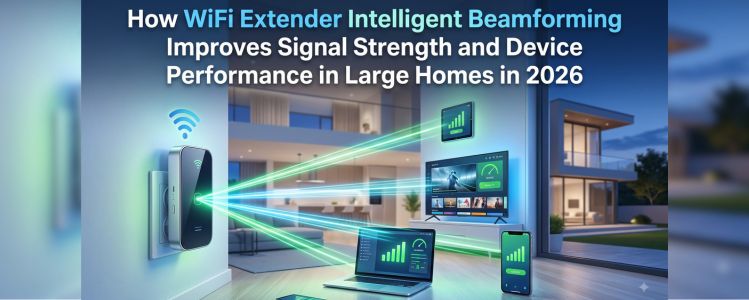
Beamforming can help focus wireless transmissions toward connected devices rather than distributing energy equally across the entire environment.
When a compatible device is located at a distance from the extender, intelligent beamforming may help improve the quality of the signal reaching that device.
Potential benefits include:
These improvements can be particularly useful in larger homes where devices may be located far from the primary router.
Modern homes can have dozens of connected devices operating simultaneously.
Examples include:
Intelligent wireless technologies can help networking equipment manage communication with these devices more efficiently.
However, beamforming works alongside other technologies rather than replacing bandwidth management, channel selection, or proper network configuration.
High-resolution streaming requires stable wireless connectivity. A weak or inconsistent connection can result in:
By improving communication between a compatible extender and device, beamforming may help provide a more consistent connection for streaming applications.
This can be useful for households using:
Actual streaming performance also depends on internet speed, network congestion, and the capabilities of the connected devices.
Gaming applications can be sensitive to connection stability and latency. A stronger and more consistent wireless connection can help reduce problems associated with weak signals.
Beamforming may contribute to:
For stationary gaming systems, Ethernet connections can still provide an excellent alternative when practical.
Remote workers depend on stable connectivity for daily tasks. Applications such as:
Can be affected by inconsistent WiFi. A properly configured extender with compatible beamforming technology can help provide stronger wireless connectivity in home offices located farther from the primary router.
A successful Netgear extender setup is important for maximizing the performance of a compatible extender.
During setup, homeowners should consider:
An extender positioned too far from the router may receive a weak source signal, limiting the performance available to connected devices.
The 192.168.1.1 address is commonly used as a private local IP address by some routers. When supported by the specific router, entering this address into a web browser while connected to the local network may open the router’s administration interface.
Users may use the interface to manage settings such as:
Not every router uses 192.168.1.1, so users should confirm the correct management address for their particular device.
Beamforming cannot overcome every physical obstacle.
For better performance, an extender should generally be placed where it receives a strong enough signal from the main router while remaining close enough to the areas requiring additional coverage.
Avoid placing an extender:
Good placement gives intelligent wireless technologies a better foundation for effective operation.
Firmware updates can improve compatibility, security, stability, and wireless performance. Users should periodically check for updates for their router and compatible extender.
Other optimization steps include:
Wireless networking is becoming increasingly automated. Future WiFi extenders may combine beamforming with:
These technologies could allow home networks to respond more effectively to changing device locations and wireless conditions.
Intelligent beamforming is helping WiFi extenders improve wireless communication in large homes by focusing transmissions more effectively toward compatible connected devices. When combined with modern wireless standards, proper placement, updated firmware, and intelligent network management, beamforming can contribute to stronger signal quality and more consistent device performance.
For homeowners, completing a proper Netgear extender setup is an important first step toward reliable whole-home coverage. The 192.168.1.1 address may provide access to a compatible router’s local management interface, although the correct address varies between devices.
As households continue adding smart TVs, gaming systems, security cameras, workstations, and connected appliances, intelligent WiFi technologies will become increasingly important. A well-planned wireless network can help large homes achieve better coverage, improved reliability, and a more consistent connected experience throughout 2026.

Dave Francis is a WiFi network expert and a technical writer dedicated to helping users optimize their home networks. He focuses on providing clear, actionable steps to help readers get the best service out of their devices. With the background in Information-Technology and passion for WiFi devices, he provides practical advice and solutions for setting up and managing Wi-Fi devices. He breaks down technical issues and offers simplified solutions through easy guides and tutorials.


