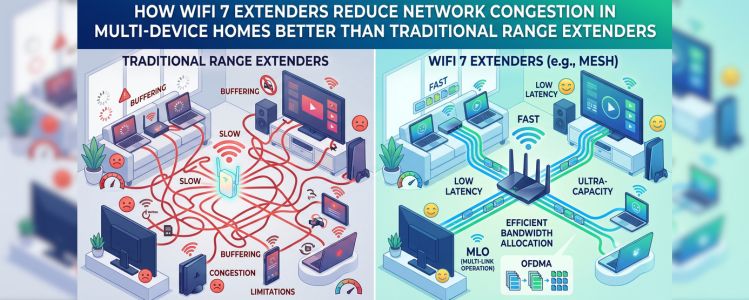
Modern homes are more connected than ever in 2026. From smartphones and laptops to smart TVs, gaming consoles, security cameras, and IoT devices, the average household now supports dozens of wireless connections simultaneously. As more devices compete for bandwidth, network congestion has become one of the biggest causes of slow internet speeds, buffering, and unstable connections.
While traditional WiFi range extenders helped improve coverage, they often struggle to handle the heavy traffic generated by today’s connected homes. WiFi 7 extenders are changing this by offering higher speeds, lower latency, and more intelligent traffic management. Whether you’re completing a Routerlogin.net setup for a new network or managing advanced router settings through 192.168.1.1, upgrading to a WiFi 7 extender can significantly improve your home’s wireless performance.
The number of internet-connected devices continues to grow every year.
Today’s households commonly include:
Each connected device shares the available bandwidth, increasing the likelihood of congestion during peak usage hours.
Network congestion occurs when too many devices attempt to transmit data across the network at the same time.
Common symptoms include:
Even high-speed internet connections can experience poor performance if the wireless network becomes overloaded.
Older range extenders were primarily designed to expand wireless coverage.
However, many traditional models have limitations such as:
As smart homes become more complex, these limitations become increasingly noticeable.
WiFi 7 introduces several advanced technologies that help reduce congestion.
Key improvements include:
Together, these innovations allow more devices to communicate simultaneously without overwhelming the network.
One of WiFi 7’s most significant advancements is Multi-Link Operation.
Instead of using only one wireless band, devices can communicate across multiple frequency bands simultaneously.
Benefits include:
This allows the network to distribute traffic more efficiently during busy periods.
Modern families often have dozens of devices connected simultaneously.
Typical activities include:
WiFi 7 extenders are specifically designed to manage these demanding environments with greater efficiency than older extender models.
Applications such as:
require extremely low latency.
WiFi 7 reduces communication delays, providing faster response times and smoother user experiences.
Moving between rooms should not interrupt wireless connectivity.
WiFi 7 extenders provide improved roaming capabilities by allowing devices to transition between the router and extender more smoothly.
This helps eliminate:
The result is more consistent whole-home coverage.
A proper Routerlogin.net setup ensures that your router and extender are configured for maximum efficiency.
During setup, users can:
Correct configuration lays the foundation for better network performance.
Accessing your router through 192.168.1.1 allows for more detailed network management.
From the administrator dashboard, you can:
These tools help reduce congestion and improve overall network stability.
Manufacturers frequently release firmware updates that include:
Keeping both the router and WiFi 7 extender updated ensures optimal operation.
Smart home equipment constantly exchanges small amounts of data.
Examples include:
WiFi 7 extenders handle these simultaneous connections more efficiently, reducing delays and improving automation reliability.
Traditional extenders often divide available bandwidth equally among connected devices.
WiFi 7 systems use intelligent traffic management to allocate resources more effectively.
This ensures that demanding applications receive the bandwidth they need without disrupting lower-priority devices.
WiFi 7 incorporates advanced technologies that improve spectrum efficiency.
This helps minimize interference from:
Cleaner wireless communication results in more stable network performance.
As internet speeds continue increasing and connected devices become more advanced, network demands will continue to grow.
WiFi 7 is designed to support emerging technologies such as:
Investing in WiFi 7 helps prepare your network for future connectivity needs.
A properly configured WiFi 7 network should provide:
These improvements create a better experience for every connected device.
As connected homes continue expanding in 2026, traditional range extenders often struggle to keep pace with increasing bandwidth demands and growing numbers of wireless devices. WiFi 7 extenders offer a significant performance upgrade by reducing congestion, lowering latency, improving roaming, and intelligently managing network traffic.
By completing a proper Routerlogin.net setup, optimizing advanced settings through 192.168.1.1, and keeping firmware up to date, homeowners can unlock the full benefits of WiFi 7 technology. For families with multiple connected devices, upgrading to a WiFi 7 extender is one of the most effective ways to achieve faster, more reliable, and future-ready whole-home wireless coverage.
Tags: WiFi Extender
Dave Francis is a WiFi network expert and a technical writer dedicated to helping users optimize their home networks. He focuses on providing clear, actionable steps to help readers get the best service out of their devices. With the background in Information-Technology and passion for WiFi devices, he provides practical advice and solutions for setting up and managing Wi-Fi devices. He breaks down technical issues and offers simplified solutions through easy guides and tutorials.


