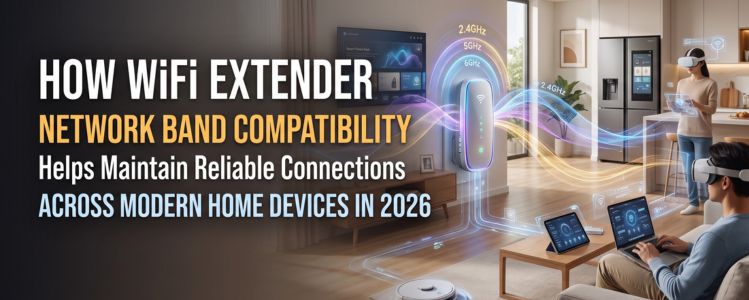
Modern homes depend on smartphones, laptops, smart TVs, gaming consoles, security cameras, smart speakers, and IoT devices that use different wireless technologies. Ensuring compatibility between an extender and the devices it serves is therefore important for maintaining reliable connectivity. During Netgear extender setup, users need to consider supported WiFi bands, wireless standards, and device capabilities. Likewise, Routerlogin.net setup can help users access supported router configuration features and review wireless settings that influence how connected devices communicate across the home network.
WiFi network band compatibility refers to the ability of a router, extender, and connected device to communicate using supported wireless frequency bands.
Common WiFi bands include:
Each band has different characteristics. The 2.4 GHz band generally provides greater range and better penetration through obstacles, while 5 GHz can provide higher speeds over shorter distances. The 6 GHz band can provide additional spectrum for compatible devices but requires supported hardware.
A WiFi extender must support the appropriate bands for the devices and router in the network.
A single household may have devices released across several generations of WiFi technology. An older smart plug may primarily use 2.4 GHz, while a newer laptop or smartphone may support 5 GHz or 6 GHz.
If an extender does not support the band required by a particular device, that device may be unable to connect through the extender or may need to use another available connection. Band compatibility can therefore influence:
Understanding these differences helps users select and configure an extender more effectively.
The 2.4 GHz band remains important because many smart-home devices use it. Devices such as:
May depend on 2.4 GHz connectivity. Because 2.4 GHz generally travels farther than higher-frequency bands, it can be useful for devices located farther from the main router. A compatible extender can help extend coverage for these devices, provided the extender and router configuration support the required wireless mode.
5 GHz is commonly used by devices that require greater wireless throughput. Examples include:
However, 5 GHz signals generally have shorter effective range than 2.4 GHz signals. An extender that supports 5 GHz can help improve connectivity in areas where a compatible device is too far from the main router but still within a suitable range of the extender.
Modern WiFi standards are introducing additional capabilities, including 6 GHz operation on compatible hardware. WiFi 6E and WiFi 7 devices can take advantage of the 6 GHz band when supported by the router, extender, and client device.
However, users should not assume that an older extender can automatically provide 6 GHz connectivity. Hardware and firmware support are important. Before upgrading, users should check:
This helps avoid purchasing equipment that cannot provide the expected functionality.
During Netgear extender setup, users should verify which wireless bands are supported by both the primary router and extender. If the extender supports dual-band operation, it may communicate using both 2.4 GHz and 5 GHz connections, depending on the model and configuration.
Users should also confirm that the extender is receiving a sufficiently strong connection from the router. Simply supporting the same frequency band does not guarantee excellent performance. Placement, interference, channel conditions, and network configuration also affect actual results.
During Routerlogin.net setup, users may access router management features that can help them review wireless configuration settings. Depending on the router model, available settings may include:
These settings can help users understand whether the router and extender are configured consistently. The exact interface and available options vary according to the router model and firmware version.
Smart homes often contain devices operating on different frequency bands simultaneously. For example, a smart camera may use 2.4 GHz while a gaming console uses 5 GHz. If an extender supports both bands, it can provide broader compatibility across the household.
However, users should remember that extending coverage does not automatically increase the performance of every device. The quality of the connection between the extender and router remains important.
Several issues can occur when network bands are not properly matched.
Users can improve reliability by following several practical steps:
These steps can help create a more compatible wireless environment.
The number and variety of connected devices continue to grow. Homes now combine legacy IoT products with modern smartphones, WiFi 6 devices, WiFi 6E equipment, and emerging WiFi 7 hardware.
This makes network compatibility increasingly important. Instead of focusing only on maximum advertised speed, homeowners should consider whether their router, extender, and devices can communicate effectively across the required frequency bands.
WiFi extender network band compatibility plays an important role in maintaining reliable connections across modern home devices in 2026. Different devices rely on different frequency bands and wireless standards, making compatibility a key consideration when expanding home coverage.
During Netgear extender setup, users should verify supported bands, wireless standards, device requirements, and extender placement. Meanwhile, Routerlogin.net setup can provide access to supported router management settings that help users review and optimize their wireless environment.
By choosing compatible equipment and maintaining appropriate configurations, homeowners can build a more reliable network capable of supporting today’s increasingly connected homes.

Dave Francis is a WiFi network expert and a technical writer dedicated to helping users optimize their home networks. He focuses on providing clear, actionable steps to help readers get the best service out of their devices. With the background in Information-Technology and passion for WiFi devices, he provides practical advice and solutions for setting up and managing Wi-Fi devices. He breaks down technical issues and offers simplified solutions through easy guides and tutorials.


